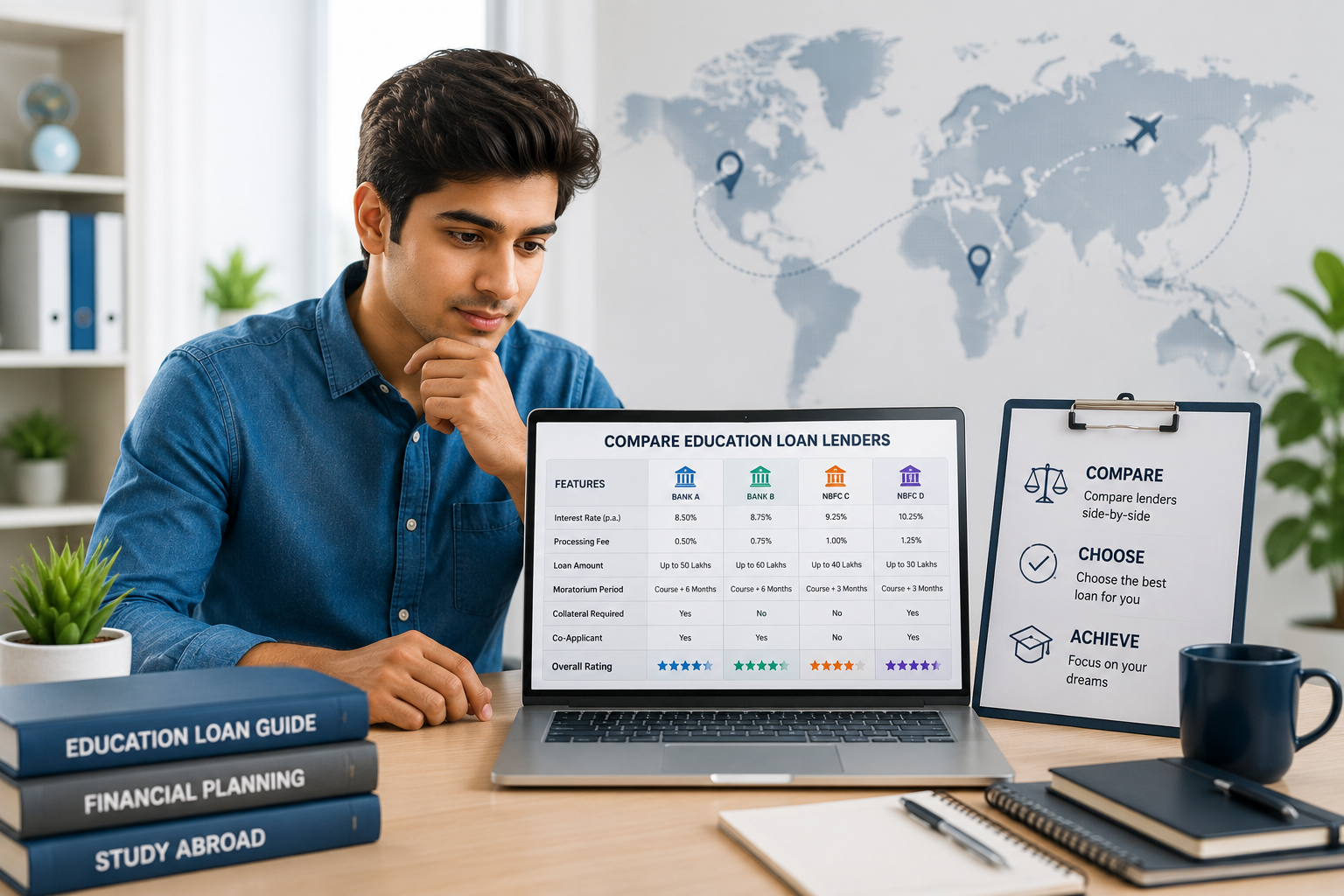
Selecting an education loan is about much more than choosing the lowest interest rate. The ideal lender depends on your university, destination country, course, loan amount, co-applicant profile, collateral availability, credit history, application timeline and disbursement requirements. Study Sahara compares multiple lender categories to help you make the same informed decision a financial consultant would.
The right question isn't which lender offers the lowest advertised interest rate. The right lender is the one that best matches your academic profile, funding requirement, approval probability and study abroad timeline.
Which lender is most likely to approve your profile based on university, course and financial strength?
Compare processing fees, margin money, collateral expenses and repayment terms, not just interest rates.
Can the lender complete approval and disbursement before your university, visa or admission deadlines?
Evaluate moratorium, prepayment, foreclosure rules and long-term repayment flexibility.
Many students begin by searching for the lowest advertised interest rate, but choosing the right education loan involves much more. Every lender has different eligibility criteria, documentation, approval timelines and repayment terms. Study Sahara helps you compare lenders based on your complete profile, ensuring you choose the option that offers the best balance of approval chances, affordability and convenience.
A profile rejected by one lender may qualify with another. Universities, courses, country, co-applicant income and collateral requirements vary significantly across lenders.
Processing fees, margin money, repayment flexibility, collateral requirements and hidden costs can make a loan more expensive than it initially appears.
Your lender should be able to meet admission, tuition fee, CAS, I-20, visa and university deadlines without unnecessary delays.
Every lender serves a different purpose. The ideal option depends on your financial profile, study destination, required loan amount, processing timeline and repayment preferences.
Public sector banks are often preferred for students seeking secured education loans with competitive interest rates and long-term affordability.
Families with acceptable collateral, complete documentation and sufficient processing time.
Legal verification, collateral valuation, branch processing and documentation may increase approval timelines.
Private banks combine structured banking with quicker digital processing and selected collateral-free education loan options.
Students with eligible co-applicants who prefer faster processing while retaining traditional banking support.
Compare sanction conditions, processing fees, repayment flexibility and lender policies carefully.
NBFCs often provide quicker decisions, profile-based assessments and higher collateral-free possibilities for eligible students.
Students seeking quicker approvals, flexible documentation and profile-based funding options.
Compare total borrowing cost, tenure, prepayment rules and repayment flexibility before choosing.
International lenders may be suitable for students with strong overseas admissions who have limited access to Indian collateral or co-applicant support.
Students requiring alternative funding routes based on university strength and international eligibility.
Evaluate APR, currency exposure, origination fees, repayment terms and university eligibility before applying.
Every lender category offers unique advantages. Instead of selecting a lender based only on interest rates, compare approval probability, processing speed, collateral requirements and long-term repayment flexibility.
| Comparison Factor | Public Banks | Private Banks | NBFCs | International Lenders |
|---|---|---|---|---|
| Best For | Students with collateral, complete documentation and enough processing time. | Students preferring bank funding with quicker servicing and selected unsecured options. | Profile-based approvals, faster processing and flexible documentation. | Students with strong international admissions and limited Indian collateral or co-applicant support. |
| Collateral | Primarily secured education loans. | Both secured and selected unsecured loan options. | More flexible collateral-free routes. | Usually no Indian property collateral. |
| Processing Speed | Moderate to Slow | Moderate | Fast | Mostly Digital |
| Cost | Generally lower for secured loans. | Moderate depending on profile. | Flexible but may cost more. | Compare APR, fees and currency impact. |
| Best When Deadline Is Close | Only if documentation is already ready. | Good option. | Highly Recommended. | Depends on university eligibility. |
Instead of randomly applying to multiple lenders, use this consultant-style decision guide to identify the lender category most suitable for your profile.
Public sector banks are usually the first choice when you have acceptable collateral, complete documentation and enough processing time before your admission deadlines.
Compare private banks and education-focused NBFCs that evaluate co-applicant income, academic profile and university strength.
NBFCs and selected international lenders may offer greater flexibility than traditional bank routes depending on your profile.
Explore international lenders or profile-based education loan options that focus more on your university and future employability.
Don't apply randomly again. First identify the reason for rejection, improve your profile and then compare lenders whose policies better match your financial situation.
Get Free Lender ReviewA lower advertised interest rate does not always mean a lower education loan cost. Before choosing a lender, compare every expense that can affect your total repayment amount and study abroad timeline.
Compare the actual sanctioned interest rate, whether it is fixed or floating, and how it impacts your long-term repayment.
Evaluate processing fees, GST, legal charges, valuation costs and other hidden expenses before accepting a loan offer.
Check how much personal contribution is required and whether your chosen lender offers flexibility for education expenses.
Legal verification, valuation charges, mortgage registration and documentation can increase the total borrowing cost.
Ensure your lender can release tuition, living expenses, insurance, travel and country-specific payments on time.
Compare foreclosure charges, part-payment options, balance transfer facilities and future interest savings.
Small mistakes during lender selection can delay your admission, increase costs or even result in rejection. Compare carefully before submitting any application.
Applying to multiple lenders without comparing eligibility and approval probability.
Choosing only the lowest advertised interest rate without reviewing total borrowing cost.
Waiting until university deadlines before starting the education loan process.
Ignoring visa, CAS, I-20 and tuition payment timelines while selecting a lender.
Assuming every lender provides collateral-free education loans for all universities.
Submitting incomplete co-applicant income, bank statements or collateral documents.
Comparing only interest rates while ignoring repayment flexibility and lender policies.
Not keeping an alternative lender option when the first application gets delayed or rejected.
Choosing the right education loan lender can be confusing. Here are answers to the questions students ask us most frequently before applying for study abroad funding.
Let our education loan specialists compare banks, private banks, NBFCs and international lenders based on your academic profile, university, country, funding requirement and timeline.